
The Ismaili Center, Houston — A New U.S. Cultural and Architectural Landmark — Opens to the Public on December 13
Ismaili Center, Houston
Ismaili Center, Houston
The Ismaili Center, Houston opens to the public on Saturday, December 13 with a day of complimentary community programming and tours.
HOUSTON, TX, UNITED STATES, December 11, 2025 /EINPresswire.com/ -- The Ismaili Center, Houston opens to the public on Saturday, December 13 with a day of complimentary community programming and tours. Designed by Farshid Moussavi Architecture and Nelson Byrd Woltz Landscape Architects, the first Ismaili Center in the U.S. will serve as a place for spiritual reflection, cultural exchange and public dialogue. The Ismaili Center, Houston is the seventh worldwide, joining Centers in London, Vancouver, Lisbon, Dubai, Dushanbe and Toronto.Set on 11 acres overlooking Buffalo Bayou Park, the Center marks a historic milestone for the Ismaili community and Houston’s expanding cultural landscape. Designed to serve both as a place of religious congregation and a welcoming civic space, the Center will offer a wide range of public programming, community use and collaborative initiatives. The Ismaili Center is poised to become a major resource for Houston’s nonprofit and cultural sectors, offering spaces for meetings, conferences, lectures, performances and community events.
Prominently located at the intersection of Allen Parkway and Montrose Boulevard, the Center fulfills the long-held vision of His Highness Prince Karim Aga Khan IV (1936–2025), first set in motion with the 2006 purchase of the land and brought to completion under the leadership of his son and successor, His Highness Prince Rahim Aga Khan V. The Ismaili Imamat, the office occupied by the Aga Khan, funded the construction of the Center with additional support from the Ismaili community.
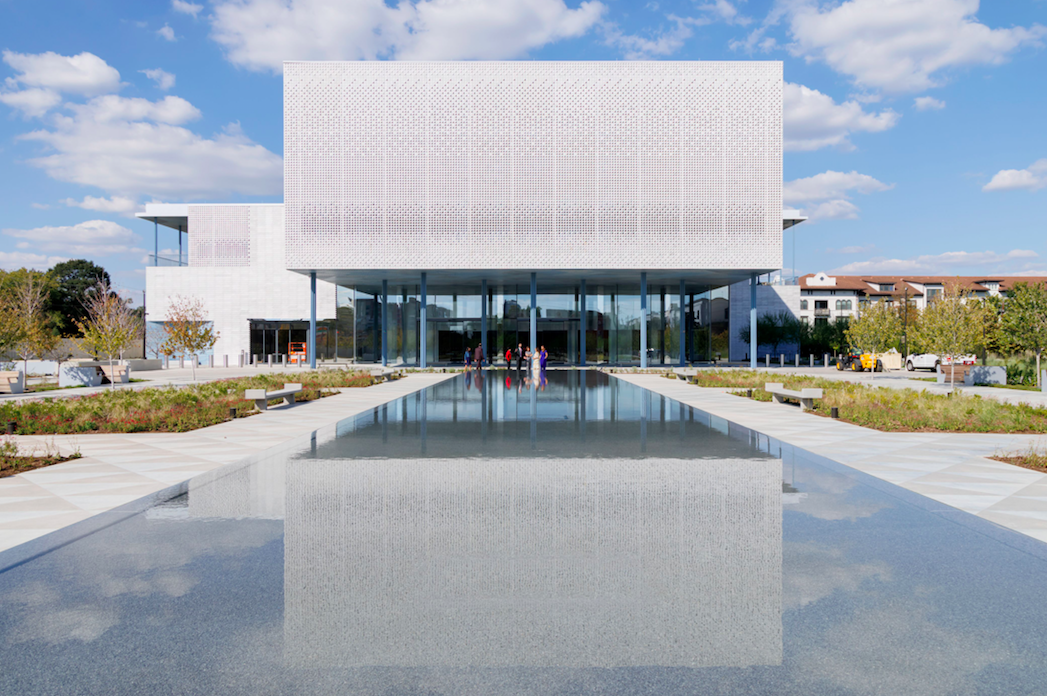
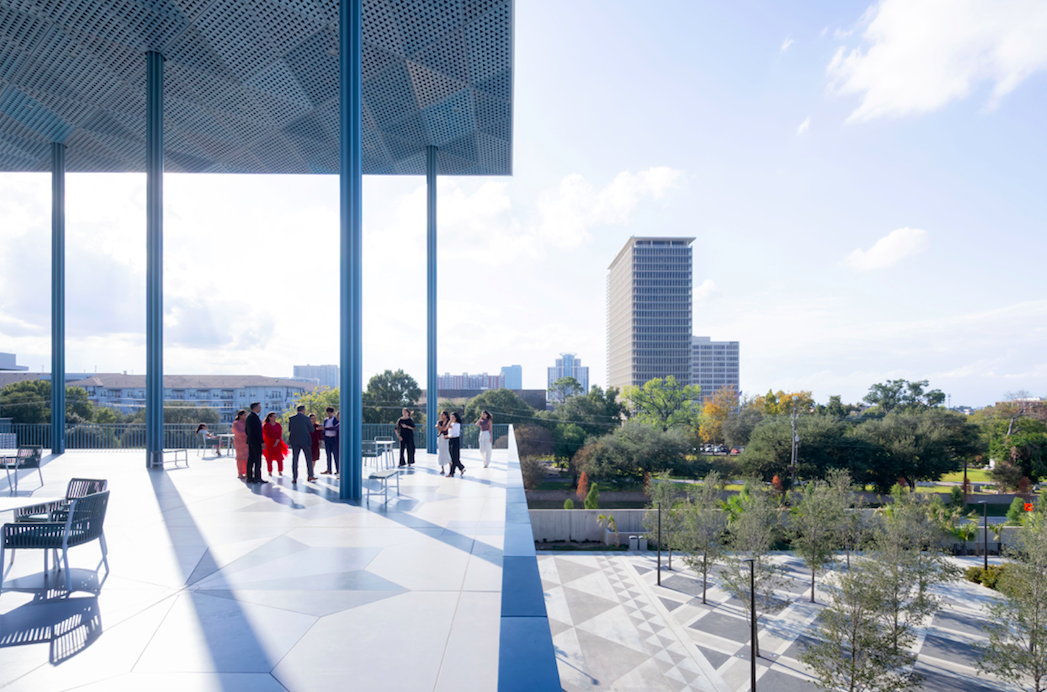
The campus features more than nine acres of gardens and courtyards encircling a luminous main structure, with tree-lined promenades, shaded terraces and tranquil water features, including a grand reflecting fountain at the primary entry. Together, the building and landscape create a serene civic sanctuary that embodies the Ismaili ethos of harmony between people, place and nature. The project team also included AKT II (engineering), DLR Group (architect and engineer of record) and McCarthy (contractor).
“The Center’s aim is to foster mutual understanding between different communities and cultures: to invite Ismailis and non-Ismailis to connect through shared events such as lectures, conferences, music recitals, and art exhibitions that nurture curiosity, celebrate difference, and encourage conversation,” said Omar Samji, spokesperson for the Ismaili Center, Houston.
A Space for Reflection, Dialogue and Discovery
Ismaili Centers around the world welcome people of all backgrounds to explore the intersections of faith, culture and civic life. The Ismaili Center, Houston embodies the Ismaili community’s commitment to peaceful pluralism, intellectual engagement and shared humanity.
Visitors will find permanent and rotating art exhibitions, a black box theater, function rooms, classrooms, administrative offices, a café and a Jamatkhana (prayer hall) that anchors the complex in devotion and community. In keeping with the Ismaili ethic of service, the Center is staffed largely by volunteers.
By welcoming organizations that advance the common good, from education and the arts to public health, environmental awareness, and social equity, the Center will nurture the exchange of ideas that strengthens Houston’s civic fabric.
“As the nation’s most diverse and inclusive global city, Houston is a fitting choice to host the country’s first Ismaili Center,” said Michael Heckman, President and CEO of Houston First. “This remarkable campus is more than an architectural landmark — it stands as a bridge across cultures and faiths, inviting Houstonians and our visitors to come together in dialogue and community building. For Houston First, it reinforces a commitment to cultural vibrancy and hospitality: fostering spaces where people from every background feel welcomed and inspired. The Center will not only enrich the Buffalo Bayou corridor but will elevate Houston’s global standing as a hub of innovation, art and connection.”
Architectural Dialogue Between Tradition and Modernity
The architecture of the Ismaili Center translates enduring ideas from across the Muslim world – structure as legible order, ornament as human scale and light as material – through contemporary craft. Inspiration from Persian domestic traditions appears in the deep verandas (eivans) and perforated stone screens that temper light and privacy. Shaded outdoor rooms pair with luminous interiors to support year-round movement between inside and out, reinforcing the Center’s civic mission as a daily destination for reflection and gathering.
Materials were chosen for beauty, clarity and longevity: stone tiles on the exterior, and inside, a restrained palette of silk-laminated glass, steel, wood paneling and ultra-high-performance concrete. An oculus crowns the central atrium, aligning sky and sanctuary. Sited above the 500-year floodplain, the building is protected, and the underground parking garage is engineered to take on water when necessary.
Landscape of Reflection and Resilience
For Woltz, the landscape represents the culmination of a decade of research into the sensory and cultural dimensions of Islamic gardens. Under the guidance of His Highness Prince Karim Aga Khan IV, the firm undertook extensive study in Spain, Egypt and India, exploring how elements such as water, geometry and enclosure shape experience. These insights informed the Center’s terraced lawns, reflecting basins and flood-adaptive gardens, designed to withstand Houston’s 500-year storm events.
Plantings form a “transect of Texas,” beginning with desert species and moving toward the Gulf Coast, an ecological narrative that echoes the adaptability of the Ismaili people in new homelands. Enclosed by sound-mitigating garden walls soon to be covered in creeping fig, the site offers a tranquil enclave connected to Houston’s ecology.
A Collaborative Achievement and a Civic Gift
The Ismaili Center, Houston adds a defining new layer to the city’s cultural landscape, joining nearby institutions such as The Menil Collection, Rothko Chapel, Asia Society Texas and the Museum of Fine Arts, Houston. More than a place of worship or art, the Center stands as a symbol of openness – where communities converge to learn from one another, celebrate shared values and imagine a more connected world.
Located at 2323 Allen Parkway (Houston, Texas 77019), the Ismaili Center, Houston is open to the public on Tuesdays, Thursdays, Saturdays and Sundays, with an expanded schedule to follow. For the most up-to-date information, including hours, please visit www.ismailicenter.org.
Photos available here (credits in the file names).
Nataly Torres
Public Content
nataly@public-content.com
Visit us on social media:
Instagram
Legal Disclaimer:
EIN Presswire provides this news content "as is" without warranty of any kind. We do not accept any responsibility or liability for the accuracy, content, images, videos, licenses, completeness, legality, or reliability of the information contained in this article. If you have any complaints or copyright issues related to this article, kindly contact the author above.
